
Charles City County Court Records After a Jail Arrest
After a Charles City arrest, custody information usually starts with Riverside Regional Jail because Charles City County uses Riverside as its regional jail facility. That roster can show booking charges, a commitment date, bond rows, detainers, housing information, and sometimes hearing fields. The formal court record is separate. It is created in Virginia's court systems when charges are filed and then updated as the case moves through hearings, amendments, reductions, dismissal, nolle prosequi, disposition, conviction, or sentencing.
The practical way to read court records after an arrest is to keep the booking side and the court side apart. Use jail inmate records for custody status, booking fields, housing, and Riverside profile information. Use jail mugshots for booking-photo questions. Use court portals and clerks for the filed criminal case. A jail charge can be an arrest, warrant, probation, or intake label; a court charge reflects what the prosecutor and court are actually processing.
Local Courts for Court Records After an Arrest
Charles City court business is concentrated around the Courthouse Road government complex, while jail custody is handled at Riverside Regional Jail in North Prince George. General District Court is at 10780 Courthouse Road, Charles City, VA 23030, mailing P.O. Box 57, phone 804-652-2188, fax 804-829-6390, with posted hours Monday through Friday, 8 a.m. to 4 p.m. It handles most traffic violations, misdemeanors, and preliminary hearings for felony matters. The presiding judge listed in the research is Hon. Matthew D. Danielson.
Juvenile and Domestic Relations District Court is at the same courthouse address and handles juvenile delinquency, status offenses, family abuse, child abuse and neglect, custody, support, visitation, and criminal cases involving family or household relationships. The presiding judge listed is Hon. Mara M. Matthews. Circuit Court records and felony prosecutions run through the Circuit Court Clerk, Victoria Washington, at 10780 Courthouse Road, mailing P.O. Box 86, phone 804-652-2105, with posted hours Monday through Friday, 8:30 a.m. to 4:30 p.m.
The Commonwealth's Attorney is the prosecutor for filed criminal charges. Tyler Klink's office is at 10780 Courthouse Road, mailing P.O. Box 95, phone 804-652-2178, with posted hours Monday through Friday, 8:30 a.m. to 4 p.m. Virginia uses Commonwealth's Attorneys rather than district attorneys. The office prosecutes felonies and some misdemeanors and is the right context for understanding why a roster charge may later appear differently in court.
How to Find Charles City County Court Records After an Arrest
The statewide starting point is the Virginia Online Case Information System. For district-level matters, use the General District Court Online Case Information System. For higher-level criminal matters, use the Virginia Circuit Court case information page and select the correct participating court or search mode. These systems are court record tools, not jail rosters, so a recent arrest may take time to appear or may appear under a different charge description than the Riverside profile.
Source image: the Virginia Judiciary OCIS entry is the statewide court-search doorway for case information.
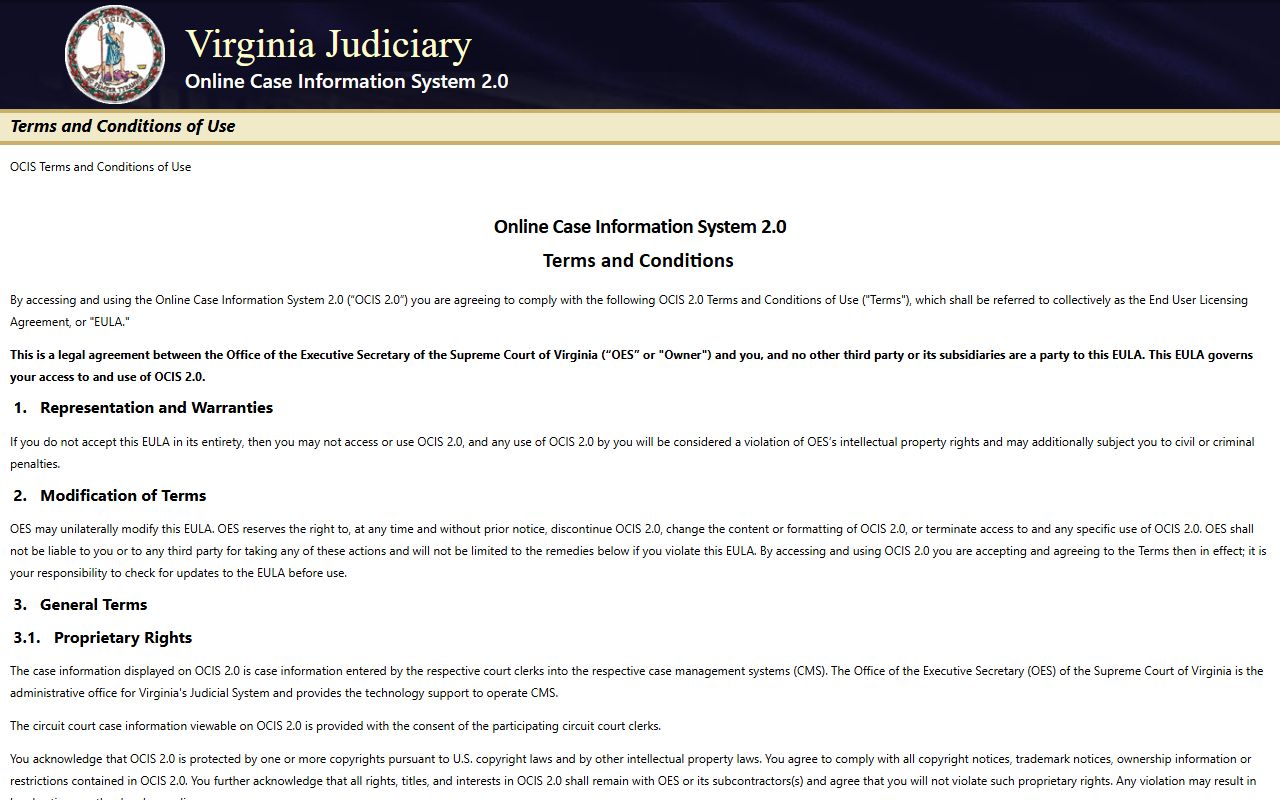
Use the court portal after checking the Riverside custody record so the name, charge wording, commitment date, and county association can be compared carefully.
- Open the applicable Virginia court case-search portal and choose the Charles City locality or court level when the portal asks for it.
- Search by defendant name first, then by case number if a court case number appears on a notice, summons, bond paper, or later court document.
- Open the case detail and read every charge row separately, including code, offense level, court date, and current status.
- For felony matters, search both district and circuit records because a felony can begin with preliminary proceedings and later move to Circuit Court.
- If the online system does not show the case, call General District or JDR at 804-652-2188, or Circuit Court at 804-652-2105.
| Search Field | Use | Charles City Notes |
|---|---|---|
| Court or locality | Selects the court database to search. | Choose Charles City or the applicable court level rather than Riverside, which is the jail facility. |
| Name | Finds cases by defendant or party name. | Use the full legal name from the jail profile when available, but check spelling variations. |
| Case number | Finds a known court case directly. | Riverside charge rows may have blank case-number fields, so this may not be available at booking. |
| Hearing date | Finds matters scheduled for a date. | Useful after a first appearance, preliminary hearing setting, or Circuit Court docket notice. |
| Case type or level | Limits traffic, criminal, civil, district, or circuit records. | Use criminal or traffic filters when the arrest involved criminal or traffic allegations. |
How Charges Get Filed After an Arrest: Complaint, Information, and Indictment
A jail booking begins with custody. A court case begins with a charging document and court filing. For a Charles City arrest, the initial jail profile may show an arrest charge, warrant charge, probation violation, or other intake description. The Commonwealth's Attorney can later proceed on the same charge, amend it, reduce it, dismiss it, decline to proceed, or seek an indictment in Circuit Court. That is why court records after a jail arrest should be checked after the roster, not substituted for the roster.
| Document | Who Uses It | What It Does | Record Effect |
|---|---|---|---|
| Complaint or warrant-based charge | Law enforcement, magistrate, or prosecutor depending on the matter. | Starts or supports the accusation that brings the person into court. | May appear early and may later be amended or replaced. |
| Information | Prosecutor. | Formally states a charge without relying on a grand-jury indictment in contexts where allowed. | Creates a filed prosecution record with charge language to track. |
| Indictment | Grand jury process for felony matters. | Moves or frames felony prosecution in Circuit Court. | Can differ from the original roster charge or district-court wording. |
Charge Status in Court Records After an Arrest
Charge status is the part of a court record that explains what has happened to each accusation. A case can have more than one charge, and each charge can have its own result. The same arrest may include a pending misdemeanor, a dismissed charge, a reduced charge, and a felony certified or indicted in another court. Do not read the first roster charge as the final court outcome.
| Status | Meaning | How to Read It |
|---|---|---|
| Pending | The charge has not reached final disposition. | Check the next court date, bond terms, and whether the case is in district or circuit court. |
| Amended | The charge wording, code, or accusation changed. | Compare the original roster charge to the current court charge before drawing conclusions. |
| Reduced | The case moved to a lesser charge or lower offense level. | The conviction, if any, may be for the reduced charge, not the arrest label. |
| Dismissed | The court ended that charge without a conviction on that count. | Other charges from the same arrest may still remain. |
| Nolle prosequi | The prosecutor declined to proceed at that time. | It is not the same as a conviction and should be read with the docket history. |
| Disposition | The final outcome of a charge or case event. | Look for plea, finding, dismissal, sentencing, or other final action. |
Bond and Release After an Arrest
Virginia bail decisions are made by judicial officers under Virginia law. Code 19.2-120 governs admission to bail and requires notice of the right to appeal an order denying bail or setting bond terms. Code 19.2-123 covers secured bond, unsecured bond, recognizance, and conditions of release that address appearance and public safety. Riverside bond rows can show case number, bond type, amount, status, percent, who set it, set date, and total, but the jail pages reviewed did not publish a complete public bond-payment schedule.
| Bond Type | How It Works | Important Limit |
|---|---|---|
| Personal recognizance | Release based on a promise to appear and obey conditions. | Violating conditions can bring the person back before the court. |
| Unsecured bond | A bond amount is set, but no secured money is paid upfront. | Money may become owed if conditions are violated. |
| Secured, cash, or surety bond | Money or a surety bond must be posted before release. | Call the court, magistrate, or Riverside before traveling to post bond. |
| No-bond hold | Custody continues unless a judge changes the order or the case resolves. | A total of zero on a jail profile may mean no bond, not free release. |
| Detainer or other hold | Another agency or case prevents release. | A person can have a bond on one charge and still remain in custody. |
Warrants That Lead to an Arrest
No official public Charles City active-warrant search was located in the research. The Charles City Sheriff's Office is the local law-enforcement agency and its official description includes executing process, writs, warrants, capiases, and papers issued by state and county courts. For warrant questions, use sheriff and court channels rather than assuming an online list exists.
For phone or in-person questions, contact the Charles City Sheriff's Office at 10780 Courthouse Road, Charles City, VA 23030, or call 804-829-9265. For a bench warrant or capias tied to a pending court case, call the court that issued it: General District or JDR at 804-652-2188, or Circuit Court at 804-652-2105. Virginia court case information may show public warrant or capias-related events, but public-safety and investigative exemptions can limit record release.
Charges vs. Convictions
An arrest and a charge are not the same as a conviction. A charge is an accusation brought into the court process. A conviction is a guilt finding or plea accepted by the court. Court records after a jail arrest can show both accusations and final outcomes, so the disposition line matters more than the arrest label when evaluating what legally happened.
| Point of Comparison | Charge | Conviction |
|---|---|---|
| Stage | Accusation after arrest, warrant, complaint, information, or indictment. | Final guilt finding, guilty plea, or adjudication on a charge. |
| Proof | Based on probable cause or charging standards. | Requires the criminal-case burden or an accepted plea. |
| Record Meaning | Shows what was alleged and prosecuted. | Shows the legally resolved offense, sentence, and collateral consequences. |
| Common Confusion | May appear on the jail roster before court review. | Should not be assumed unless the docket shows a conviction disposition. |
Sealed vs. Expunged Arrest Records
Virginia expungement is governed by Code 19.2-392.2. Expungement can apply to eligible police and court records in qualifying circumstances, such as certain dismissals or other eligible outcomes. The research did not identify a local shortcut that removes a Charles City arrest from every public or private database. Record clearing should be handled through the court process and verified with the custodian of the record.
| Point of Comparison | Sealed | Expunged |
|---|---|---|
| Public visibility | Hidden or restricted from ordinary public access. | Removed from public access under the expungement order and treated differently by law. |
| Records affected | Depends on the order and record type. | Can include eligible police and court records when the statute applies. |
| Eligibility | Depends on Virginia law and the case outcome. | Requires a qualifying circumstance and court action under Virginia law. |
| Practical step | Ask the clerk what order or rule controls access. | Use the court process rather than a private removal request alone. |
Public Access Limits on Court Records After an Arrest
Virginia FOIA, Code 2.2-3704, provides access to public records for Virginia citizens and qualifying media unless a statute permits withholding. Code 2.2-3704.01 addresses redaction when only part of a record is excluded. Code 2.2-3704.2 requires public bodies to identify FOIA officers, and Tyler Klink is the listed FOIA officer for the Commonwealth's Attorney's Office.
Law-enforcement records have their own rules. Code 2.2-3706.1 addresses law-enforcement records, while Code 2.2-3705.2 includes public-safety exclusions. Juvenile matters, family cases, sealed charges, expunged records, confidential victim information, and active investigative material can be unavailable or redacted even when other court events remain public.
Important: Charles City County Inmate Population is not a consumer reporting agency, and these records may not be used for FCRA-regulated decisions.